The population of about a combined more than 3.5 Billion or 45% of the world's inhabitants 1
(The BRICS alliance comprises over 3.5 billion people, about 45% of the world’s population (Table 1). The rationality behind this union lies in each country’s pursuit of its national interests, ultimately benefiting each member in various ways. Just as individuals work for personal benefit while unintentionally supporting others, countries align for self-preservation, economic growth, and military strength, which often overlaps with mutual interests. This is seen in historical alliances like the Allies and Central Powers in WWI or the European Union’s economic unity post-WWII.
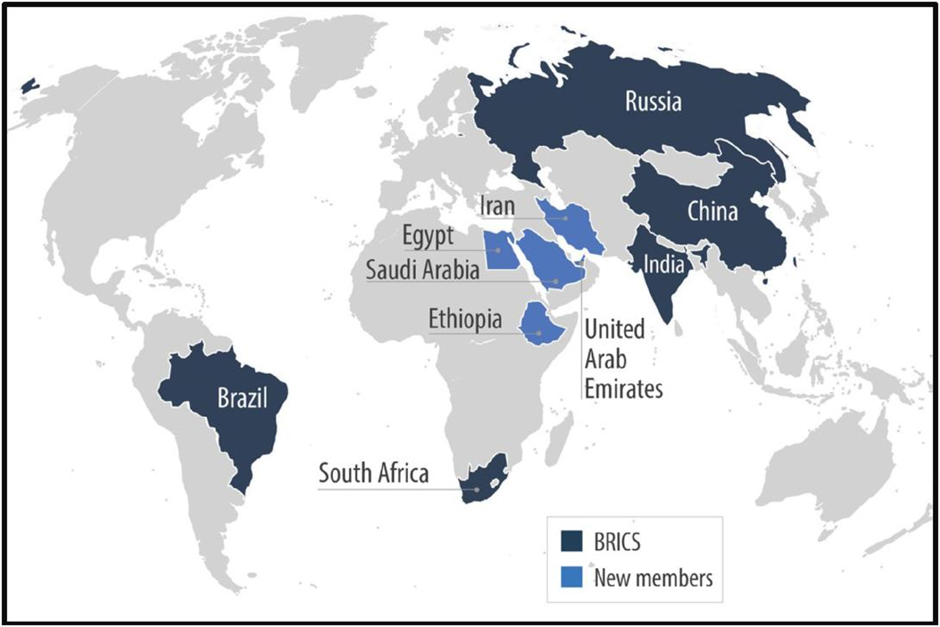
BRICS was established with similar motivations. It aims to create a multipolar world by counterbalancing Western power and providing an alternative framework for smaller or developing nations. Founded by Brazil, Russia, India, and China in 2006 and later joined by South Africa in 2010, BRICS was designed to challenge the political and economic influence of North America and Europe. With the recent expansion to include Iran, Saudi Arabia, the UAE, Egypt, Argentina, and Ethiopia, the alliance is now known as BRICS+ and holds a combined economy worth more than $28.5 trillion, representing 28% of the global economy (Figure 1).
The BRICS alliance serves as a counterweight to Western-led systems. Despite representing over 30% of the global economy, BRICS holds only 15% of the voting power in the International Monetary Fund (IMF). This disparity encourages countries in the Global South to unite, increasing their influence on the world stage. The establishment of the New Development Bank (NDB) in 2015 marked a pivotal shift, as it provides an alternative to the IMF and World Bank, both largely dominated by Western interests. By 2022, the NDB had issued over $32 billion in loans for infrastructure projects in developing countries, symbolizing the Global South’s potential to challenge traditional financial institutions.
The BRICS bloc also introduced "BRICS PAY," a payment system allowing transactions in local currencies, reducing dependence on the US dollar. Other initiatives include the Contingent Reserve Arrangement (CRA), the publication of joint statistical data, and the consideration of a BRICS reserve currency. Together, these efforts are reshaping the financial and geopolitical landscape.
For emerging economies often constrained by the IMF’s structural adjustments, BRICS presents a promising alternative. By promoting social, economic, and environmental infrastructure, BRICS provides a platform that counters G7 influence. These initiatives not only strengthen BRICS internally but also attract countries seeking partnerships outside Western-dominated frameworks.
BRICS+ now commands 29% of the global GDP, while the G7 holds 43% (Table 3). Economists project that by 2050, BRICS GDP growth will surpass that of the G7. Newly added members, such as Ethiopia and Egypt, are forecasted to experience substantial economic growth by 2050, with Ethiopia’s GDP predicted to increase by 1,170% and Egypt’s by 635%. Goldman Sachs further predicts BRICS will overtake the G7 in terms of GDP by 2050.
Within BRICS+, there are different perspectives. Countries like Brazil and India prioritize economic growth over expansion, while China and Russia advocate for broader BRICS expansion. Brazil and India, still dependent on Western systems, seek balanced diplomacy to avoid over-dependence on any single power bloc.
Pakistan has expressed interest in joining BRICS to amplify its voice in the Global South. However, India, an existing BRICS member, may oppose this, primarily due to Pakistan’s strong alliance with China. Nonetheless, Pakistan has garnered Russian support, and its ambassador to Russia has stated intentions to join under Russia’s presidency next year.
Joining BRICS+ would offer Pakistan economic benefits, including access to the NDB and CRA, which has over $100 billion in capital to support economies in crisis. Membership would open new export markets, reduce unemployment, and improve Pakistan’s international standing. BRICS membership would enable Pakistan to participate more actively in global policy dialogues, allowing it to advocate for its interests and project a positive image on the world stage.
Pakistan’s strategic ties, such as its ongoing involvement in the China-Pakistan Economic Corridor (CPEC), align with BRICS objectives. Although political instability has affected CPEC, both China and Pakistan remain committed to its long-term economic goals.
BRICS is reshaping the global order, offering developing countries a stronger international voice. As regionalism gains momentum, BRICS exemplifies the shift from a unipolar to a multipolar world order, especially as more countries explore partnerships with BRICS+. For Pakistan, membership in BRICS+ could foster stability, economic growth, and diplomatic leverage, potentially reducing long-standing tensions with India.
Ref;
1- https://data.worldbank.org/indicator/SP.POP.TOTL?end=2022&locations=BR-RU-IN-CN-ZA-SA-AR-EG-ET-
IR-AE-1W&most_recent_value_desc=true&start=2020
2- https://data.worldbank.org/indicator/NY.GDP.MKTP.CD?end=2022&locations=BR-RU-IN-CN-ZA-SA-AR-
EG-ET-IR-AE-1W&start=2020
3- https://www.atlanticcouncil.org/blogs/new-atlanticist/china-and-india-are-at-odds-over-brics-expansion/
4- https://www.bbc.com/news/world-66525474
5- https://www.visualcapitalist.com/charted-comparing-the-gdp-of-brics-and-the-g7-
countries/
6- https://investingstrategy.co.uk/financial-news/brics-vs-g7-head-to-head-comparison-
and-statistics/
7- https://tribune.com.pk/story/2447642/pakistan-plans-to-join-brics-next-year
8- https://moderndiplomacy.eu/2023/10/01/why-brics-matters-for-pakistan/