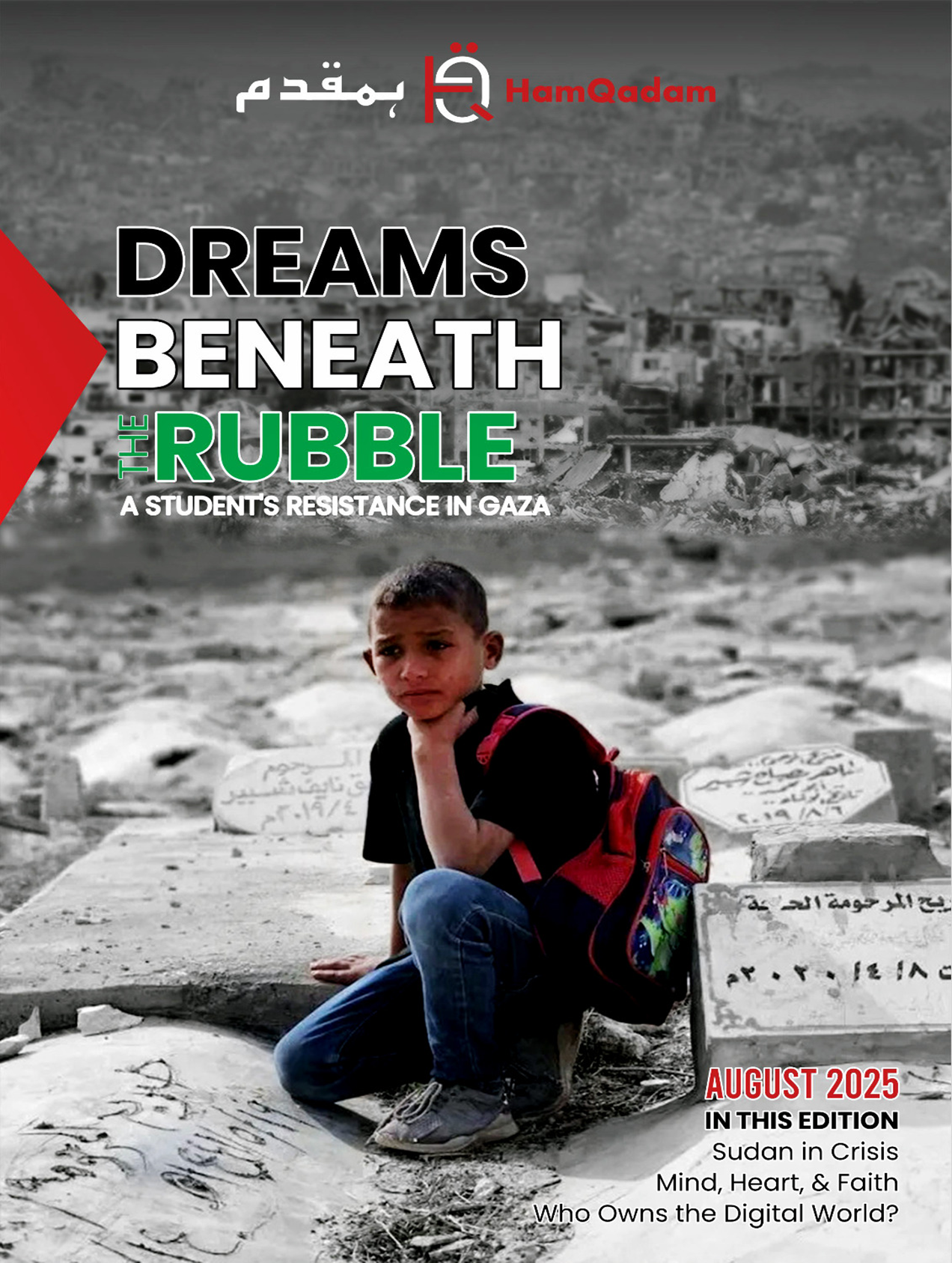
To be a student in Gaza is to study under siege, to dream beneath drones and to write amid ruins.
The war has not only destroyed buildings and ended lives. It has struck at the intellectual lifeblood of Palestinian society. Education, once a cornerstone of resilience and hope, is now suspended under the weight of Israel's relentless bombardment and mass displacement campaign.
For nearly two years, education in Gaza has been forced into a near-total halt. Most schools and universities have been destroyed or transformed into overcrowded shelters for families who lost their homes and their loved ones. Classrooms that once held the energy of young minds now echo with silence and despair. Libraries and the knowledge they once held are buried under rubble. The institutions that previously cultivated future doctors, engineers and educators have vanished, leaving an entire generation of Palestinians staring into an uncertain void.
And yet, amid this genocide, some students continue. They are a rare group, scattered across the Strip, who refuse to give up on their right to learn. They study by candlelight, record lessons on dying phones and walk miles to find a few minutes of electricity. They carry books in plastic bags from one shelter to the next. Internet access is a fleeting luxury for them. Yet, still, they persist, not for grades or degrees, but because studying in Gaza today is to resist obliteration.
I am one of them.
Before the war, I was preparing to defend my master's thesis. I spent years attending lectures, conducting research and writing with the dream of becoming the first in my family to hold a PhD in English literature. Writers like Edward Said deeply influence my passion for the field, as their work sheds light on the intersection of literature and politics. Others, like Virginia Woolf—whose voice resonated with themes of resistance and identity—have also had an immense impact on my studies.
When my laptop dies, I write by hand. When there is no internet, I whisper my ideas into voice notes. I keep my books close, not just as study materials but as symbols of who I still am: a researcher, a thinker and a student.
- Ghada Alrozzi
I remember spending countless hours reading their works in the university library, surrounded by shelves filled with knowledge and hope. Now, that university—the Islamic University of Gaza—is a pile of debris and lost dreams. Several of my professors, who once urged us to think critically and believed in knowledge as we worked tirelessly to achieve our goals, have been killed. My home is gone, and I now live in a tent with no electricity, no privacy and barely enough food for my children.
Still, I carry on. When my laptop dies, I write by hand. When there is no internet, I whisper my ideas into voice notes. I keep my books close, not just as study materials but as symbols of who I still am: a researcher, a thinker and a student.
Each sentence I write is an act of defiance. I study not just for myself, but to assert that our voices will not be erased. This war has done more than claim lives: It has tried to eradicate thought itself. Israel's targeted destruction of universities and its killing of scholars are not accidents. They are part of a broader campaign to shatter the Palestinian imagination and hope.
If Palestinians are not allowed to dream, to read or to write, then how can we ever rebuild?
Education is dangerous to systems built on injustice because it dares to envision a different world. It creates minds that challenge, question and hope. It gives ordinary people the power and capacity to think critically in their effort to advance as individuals and to advance the society around them—even and particularly when in opposition to the pillars defining the status quo.
Across Gaza, students are not asking for miracles. We are asking for the right to learn in peace—to pursue knowledge without having to dodge bombs or charge our devices in bloody hospital corridors amid the widespread cries of pain and suffering. We are not waiting for perfect conditions.
We are learning, not despite the impossible, but because we reject the impossible.
"I do not know if I will survive," I often think. "But as long as I breathe, I will not stop being a researcher." Even if my seminar is now a quiet conversation with rubble, and my classroom a dim corner of a shelter, I will continue to learn, to write and to dream.
Because in Gaza, resistance is not always armed. Sometimes, it is simply a pen that refuses to be put down.