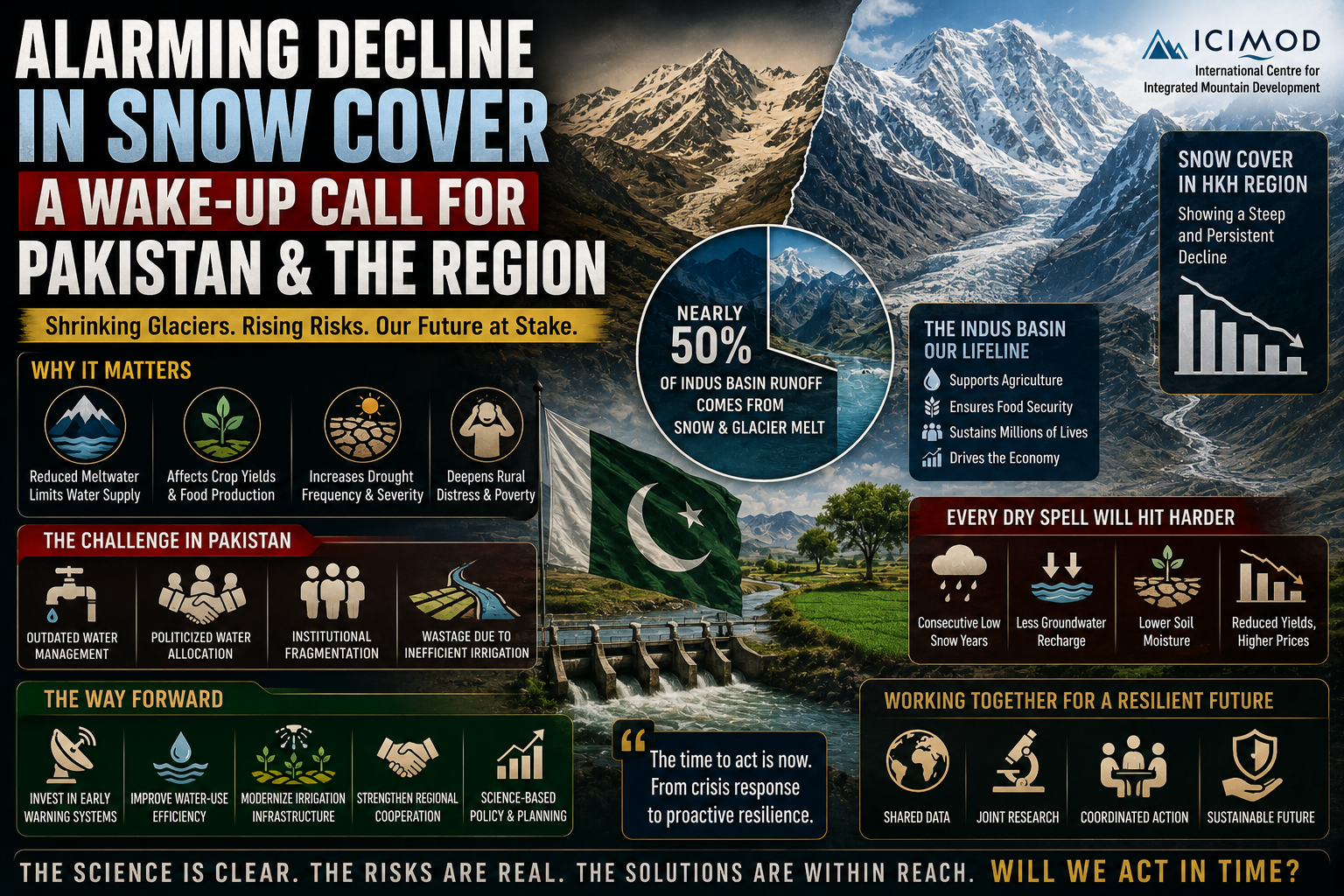
The latest findings by the International Centre for Integrated Mountain Development should serve as a wake-up call for Pakistan’s policymakers and the broader region. The alarming decline in snow cover across the Hindu Kush-Himalayan (HKH) region is not merely an environmental concern; it is a grave threat to water security, food production, and economic stability for millions who depend on the Indus River Basin. When nearly half of the basin’s runoff is tied to melt water, a sustained reduction in snow reserves signals trouble; it can no longer be dismissed as a cyclical variation.
Pakistan relies on the Indus system as its agricultural backbone, yet water management practices remain outdated and inefficient. The data cited in the report—showing a steep and persistent drop in snow cover—should compel immediate action. Instead, authorities continue to operate with a reactive mind-set, responding to crises only after they materialise. This approach is not viable in the face of accelerating climate change. As the report rightly emphasizes, the time has come to transition from emergency responses to proactive, science-based governance.
One of the most pressing concerns is the cascading effect of consecutive low-snow years. Reduced melt water not only limits immediate supply but also disrupts groundwater recharge and soil moisture levels. This creates a dangerous feedback loop: each dry year compounds the severity of the next. In an agrarian economy like Pakistan’s, this translates directly into reduced crop yields, rising food prices, and increased rural distress. Hence, ICIMOD’s warning that “every dry spell will hit harder” should not be taken lightly.
Equally concerning is the lack of coordinated water governance. Water allocation in Pakistan is often shaped by political considerations rather than scientific assessment. Provinces compete rather than collaborate, and institutional fragmentation weakens the overall response. The ICIMOD report’s call for coordinated efforts among agencies highlights a fundamental gap that must be addressed. Without integrated planning, even the best technical solutions can fail to deliver meaningful results.
The path forward requires a multipronged strategy. Investment in early warning systems is essential: accurate forecasting can help farmers and authorities prepare for shortages, adjust cropping patterns, and manage reservoirs more effectively. At the same time, water-use efficiency must be dramatically improved. Pakistan remains one of the most water-intensive agricultural economies in the world, with significant losses due to outdated irrigation methods. Modernising these systems is imperative.
Regional cooperation must also move from rhetoric to reality. The HKH region spans multiple countries, and water systems do not adhere to political boundaries. Data sharing, joint research, and coordinated policy responses are crucial to managing shared risks. In this context, institutions like ICIMOD can play a pivotal role, but their recommendations must be backed by political will at the national level. Ultimately, shrinking snow cover is a test of governance. Pakistan’s ability to adapt will determine whether this challenge evolves into a full-blown crisis or is managed with foresight and resilience. The science is clear, the risks are known, and the solutions are within reach; what remains uncertain, however, is whether the urgency of the moment will translate into meaningful action.