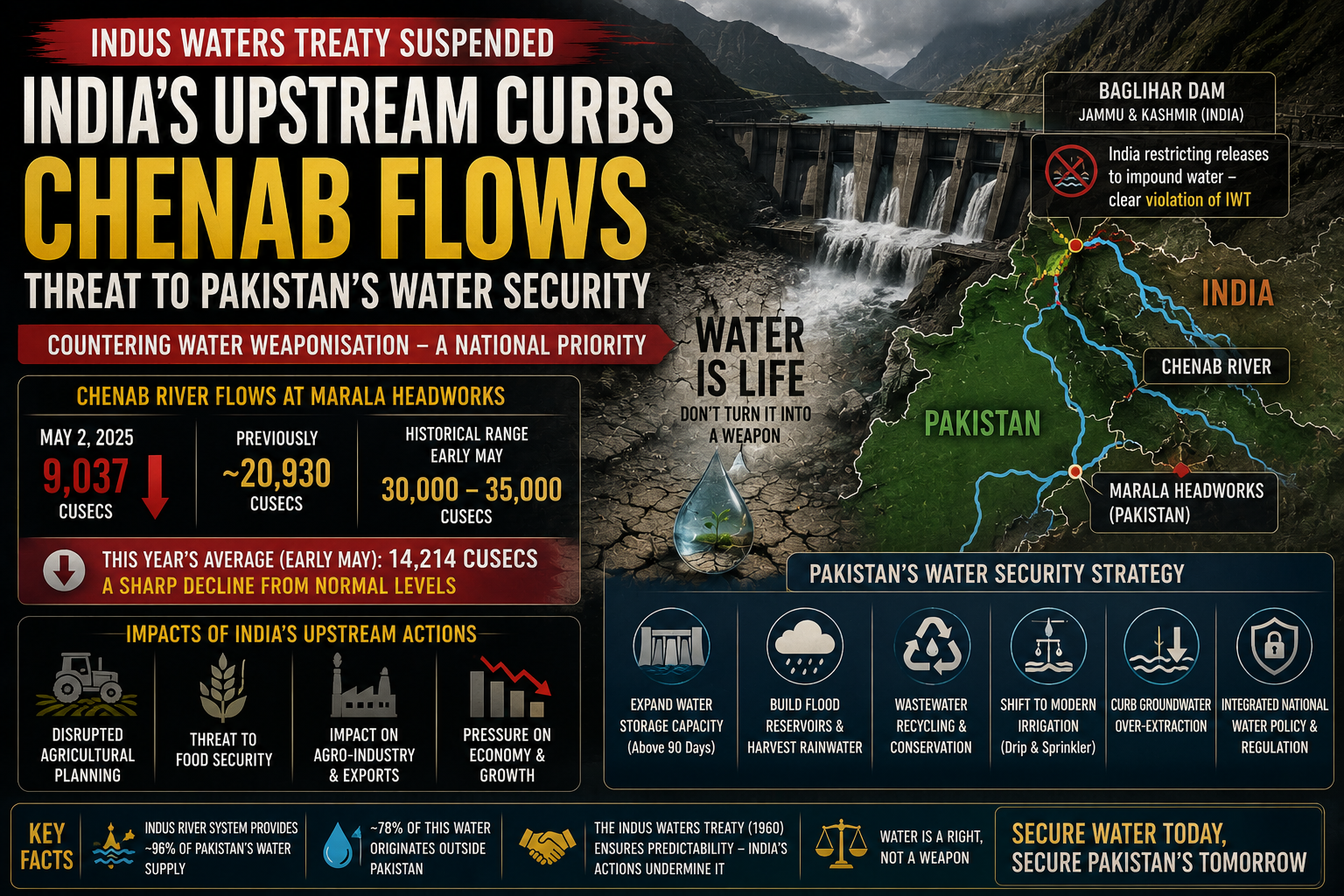
The suspension of the Indus Waters Treaty (IWT) last year continues to have far-reaching and damaging repercussions for Pakistan. Recent reports point to a notable decline in flows in the Chenab River at Marala Headworks on May 2, sharpening concerns over upstream regulation by India.
Official figures show a significant drop to 9,037 cusecs from roughly 20,930 cusecs, with India reportedly restricting releases to impound water at the Baglihar Dam, a clear violation of the IWT. It is also worth noting that historically, Chenab flows at Marala in early May range between 30,000 and 35,000 cusecs. This year, however, the average has plummeted to 14,214 cusecs, underscoring the extent to which India’s upstream interventions are reshaping downstream availability, amplifying pressure on Pakistan’s already strained water system.
This isn’t the first instance of such actions by India ever since it suspended the IWT. In December, erratic and unexplained swings in flows of the Chenab and Jhelum rivers disrupted agricultural planning across Punjab.
Similar concerns had also emerged last summer, when upstream control over releases deepened perceptions that these shared rivers were being manipulated with growing discretion, eroding the predictability the treaty was designed to ensure.
At the same time, India’s push to expand hydropower infrastructure on the western rivers allocated to Pakistan under the IWT raises fears regarding the weaponisation of water, as such projects confer a more enduring capacity to shape the timing and volume of downstream flows, well beyond the temporary effects of intermittent release adjustments.
It is imperative, then, that Pakistan must urgently develop and operationalise a multipronged water security strategy that protects it against external manipulation of river flows that could otherwise have disastrous implications for its agriculture, food security, agro-based industries and export performance, with cascading repercussions across the wider economy. Even setting aside pressures from India, Pakistan’s own water management record has been underwhelming, with inefficient irrigation practices, weak conservation efforts and chronic underinvestment in storage infrastructure steadily eroding its capacity to withstand external shocks and the impact of climate change.
Given this context, Planning Minister Ahsan Iqbal’s recent call for a cohesive water security policy assumes added urgency and relevance.
First and foremost, Pakistan must significantly expand its water storage capacity beyond the current level of 90 days, which remains well below global and regional benchmarks. For a country that has remained predominantly agrarian for most of its history, this is unacceptable, particularly since the Indus River System still accounts for around 96 percent of national water supply, 78 percent of which originates beyond its borders, a huge vulnerability indeed.
An urgent expansion of water storage capacity, including dedicated floodwater reservoirs, is essential, alongside investments in efficient hill-torrent management, urban rainwater harvesting systems and wastewater recycling.
Equally critical is improving water-use efficiency, especially in agriculture where flood irrigation continues to dominate despite longstanding expert warnings that it consumes excessive volumes of water, contributes to waterlogging and salinity, and ultimately degrades crop yields and quality.
Although modern alternatives such as drip and sprinkler irrigation offer clear gains in efficiency and soil protection, their adoption has been slowed by entrenched interests that benefit from the persistence of outdated practices. If Pakistan wants to overcome the escalating water crisis headed its way, this constraint must now be decisively overcome as a shift away from flood irrigation alone would substantially reduce overall water demand.
In parallel, unchecked groundwater extraction must be curbed as it has driven a sustained fall in water tables, triggered land subsidence, damaged infrastructure, while also harming soil quality and natural ecosystems. What is now required is a far-reaching national water policy that integrates storage, conservation and regulation into a unified framework before existing vulnerabilities deepen further.