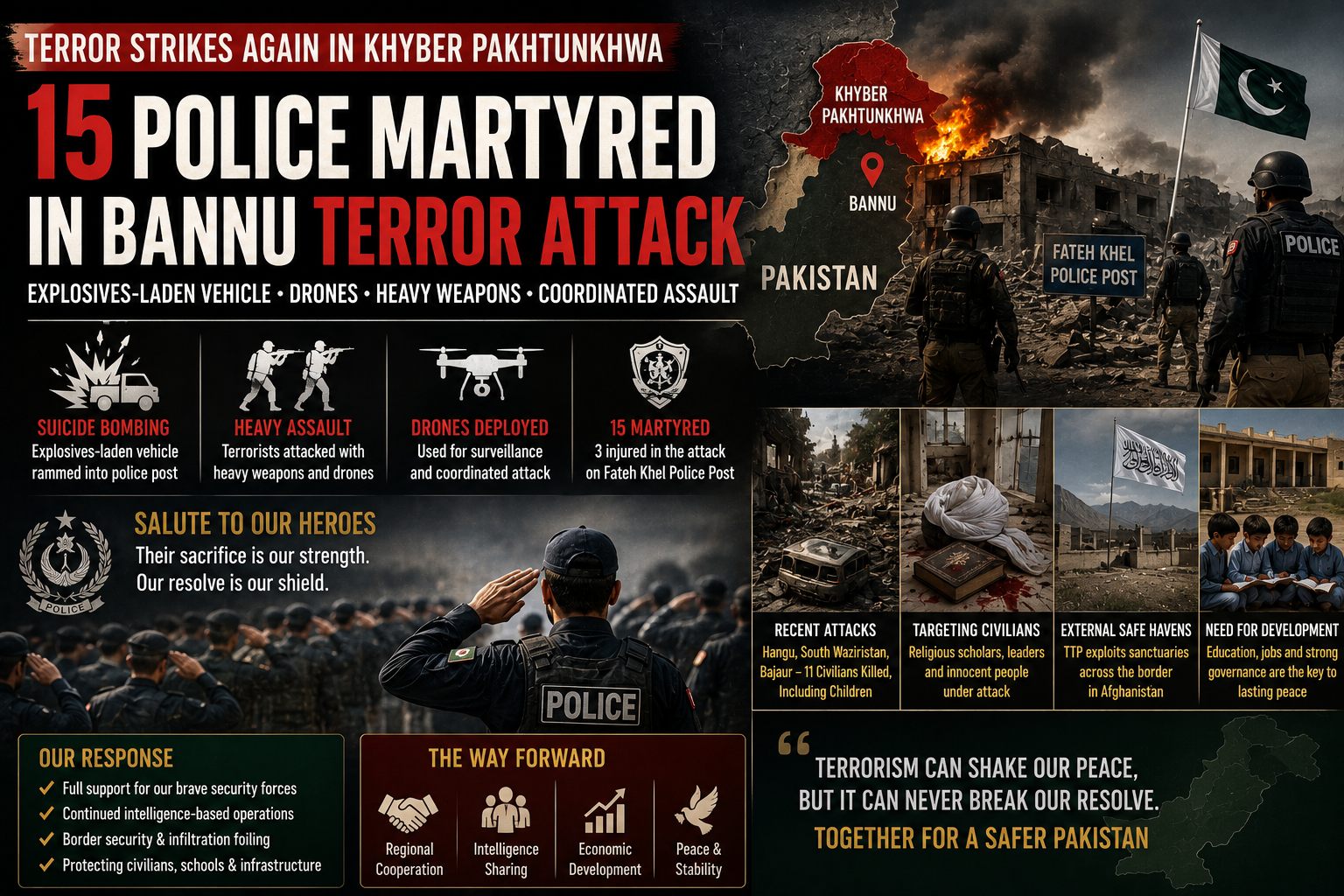
At least 15 police personnel were martyred, and three others injured late Saturday night when terrorists rammed an explosives-laden vehicle into the Fateh Khel police post in Bannu district of Khyber Pakhtunkhwa (KP), before launching a coordinated assault with heavy weapons and drones.
Although no group immediately claimed responsibility, the attack bore the unmistakable hallmarks of the India-backed Tehreek-i-Taliban Pakistan (TTP), officially designated as Fitna-al-Khawarij. Just days earlier, militant attacks in Hangu, South Waziristan and Bajaur had claimed the lives of 11 innocent civilians, including children, while injuring 16 others.
The scale and sophistication of these attacks — involving suicide bombing, multipronged ground assaults, drones and the temporary takeover of a police check-post, a school, and Shinwari Fort in Hangu — reflect both the operational capability and growing confidence of terrorist networks active along Pakistan’s western frontier.
Equally alarming is the continued targeting of civilians, who remain trapped in a cycle of violence, displacement, and insecurity after decades of conflict. The recent assassination of prominent religious scholar and local JUI-F leader Maulana Sheikh Muhammad Idris in Charsadda further underscores how extremist violence seeks not only to inflict casualties but also to silence influential voices and spread fear throughout society.
Our valiant security forces deserve full recognition for their courage and persistence in conducting intelligence-based operations and repeatedly foiling infiltration attempts along the Afghan border. Yet the resurgence of terrorism also points to deeper structural and regional challenges.
The TTP and its affiliated factions continue to exploit sanctuaries across the border in Afghanistan. Despite repeated assurances by the Afghan Taliban under the Doha framework that Afghan soil would not be used to launch attacks against other countries, there is little tangible progress on the ground.
The inability — or unwillingness — of the Afghan Taliban to curb the activities of their ideological allies has become a serious source of tension between the two neighbours and an issue of growing concern among countries farther afield.
At the same time, this challenge cannot be addressed through military means alone. Militancy flourishes where governance is weak, economic opportunities are limited and public confidence in state institutions has eroded. Durable peace in KP will require sustained investment in development, education, and the rehabilitation of conflict-affected communities.
Protecting schools, hospitals and civilian infrastructure must remain a priority for both provincial and federal authorities.
On the diplomatic front, Islamabad is right to engage influential players such as China and Russia, both of which maintain ties with the interim Taliban administration. Their influence could help persuade Kabul that regional stability and counterterrorism cooperation serve the interests of all stakeholders.
A coordinated regional approach involving security cooperation, intelligence sharing and economic incentives may prove more effective than public recriminations alone.
The sacrifices of civilians and security personnel must not be reduced to routine headlines. Pakistan has demonstrated both resolve and commitment in confronting terrorism through military operations, intelligence coordination and regional diplomacy.
What remains uncertain, however, is whether the Afghan Taliban leadership is prepared to match its assurances – during informal talks last month in Urumqi – with meaningful action against groups using Afghan soil to destabilize neighboring countries.