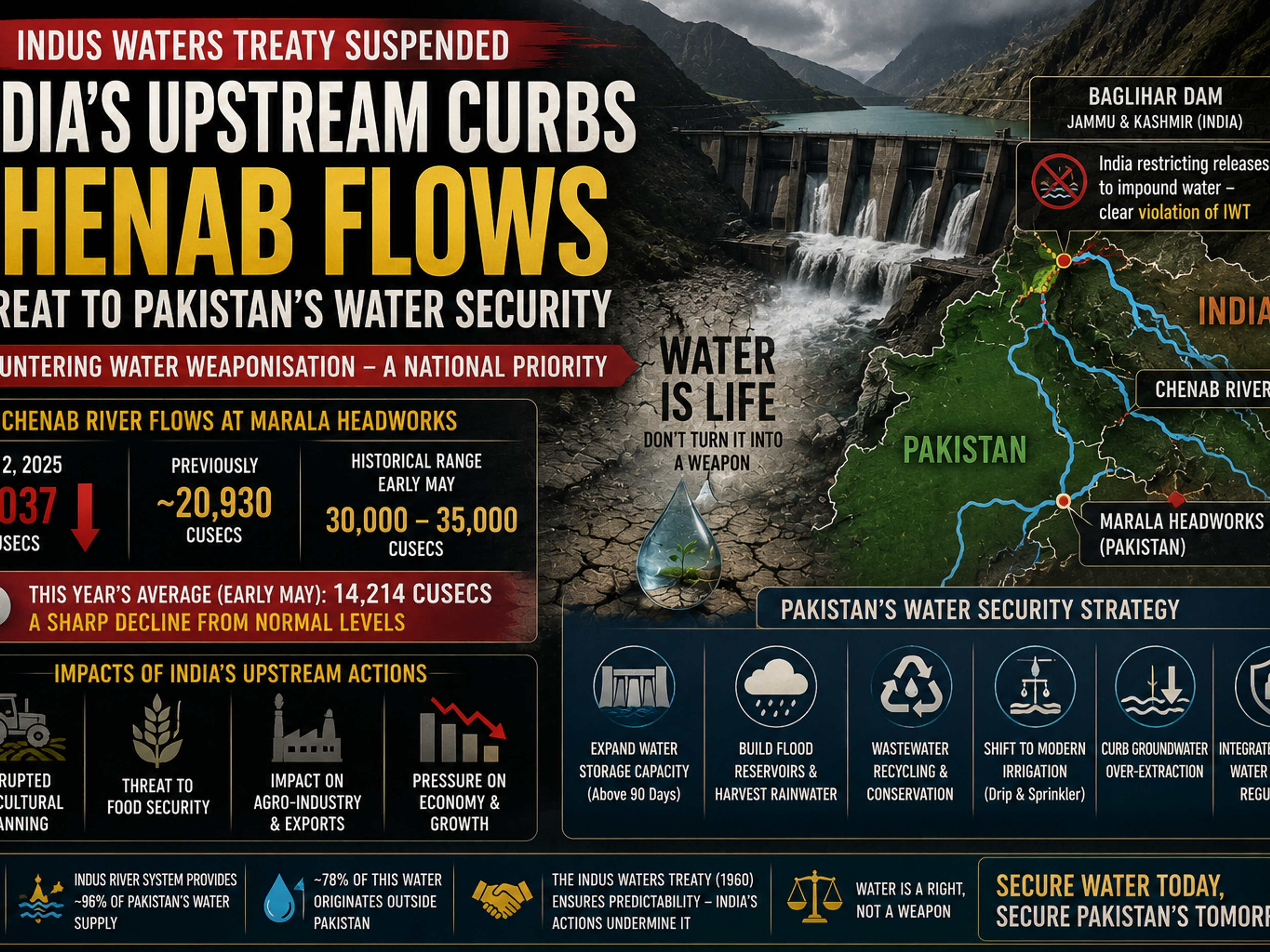
India’s attempt to weaken the sanctity of the Indus Waters Treaty has elevated a long-standing bilateral concern into a much broader international question: can countries still rely on treaty obligations when political considerations begin to override legal commitments? Speaking at the 4th High-Level International Conference on Water in Dushanbe, Climate Change Minister Musadik Malik was therefore right to frame the issue as one extending far beyond South Asia. What is at stake is not merely the future of a single agreement but the credibility of treaty-based governance itself.
For more than six decades, the Indus Waters Treaty stood as one of the few examples of sustained cooperation between two hostile neighbours. It survived wars, military crises and prolonged political tensions. That durability mattered because it demonstrated that water, perhaps more than any other shared resource, could be insulated from geopolitical disputes through clear legal frameworks and mutual obligations.
The danger today is that this principle is being tested. As Dr Malik pointed out, climate stress, changing political realities and weakening respect for multilateral mechanisms are creating new vulnerabilities for countries dependent on shared river systems. The response to those pressures should be stronger cooperation, greater transparency and improved dispute-resolution mechanisms. Using climate change as a justification for unilateral reinterpretation of established agreements points in the opposite direction.
Pakistan’s concern is therefore entirely legitimate. Water security is inseparable from food security, economic stability and social cohesion. For a lower-riparian state dependent on river flows originating upstream, predictability matters as much as volume. Farmers make planting decisions, irrigation systems are designed and reservoirs are managed on the assumption that agreed frameworks will continue to operate. Once uncertainty enters the equation, the consequences extend far beyond diplomacy.
The implications are also global. Shared river basins exist across Asia, Africa, Europe and the Americas. If upstream states begin treating treaty obligations as optional whenever political tensions arise, the resulting precedent will not remain confined to one region. Countries across multiple river systems could face growing uncertainty regarding access, allocation and long-term planning.
This is precisely why the minister’s call for stronger international protections deserves serious consideration. The international system already contains enforcement mechanisms in areas such as trade, nuclear safeguards and financial regulation. Yet water governance continues relying heavily on assumptions of good faith and voluntary compliance. Those assumptions become increasingly fragile when geopolitical tensions intensify.
The recent court of arbitration ruling referenced by Pakistan further underlines the importance of legal processes. Disputes over technical issues are inevitable in complex water-sharing arrangements. The proper response is adjudication through agreed mechanisms rather than unilateral action. That principle is central to the rule-based order many states claim to support.
The broader context makes the issue even more urgent. Climate change is accelerating glacier retreat, altering rainfall patterns and increasing pressure on already stressed water systems. Pakistan, despite contributing a tiny share of global emissions, remains among the countries most exposed to floods, droughts and climate-related disruptions. The combination of environmental stress and political uncertainty creates risks that neither diplomacy nor development planning can ignore.
There is also a humanitarian dimension often overlooked in strategic discussions. Water disputes are ultimately about people. Reduced certainty over water availability affects farmers, rural communities and households whose livelihoods depend directly on stable access to shared resources. The costs are measured not only in economic indicators but in lost incomes, food insecurity and increased vulnerability.
Pakistan’s proposal for stronger international covenants, compulsory third-party dispute resolution and meaningful consequences for violations reflects a recognition that existing safeguards may no longer be sufficient. Whether those ideas gain wider support remains to be seen, but the underlying concern is difficult to dismiss.
The principle itself is straightforward. Treaties exist precisely to provide stability during periods of tension. If agreements that have survived decades of conflict can be weakened by unilateral political decisions, confidence in international commitments inevitably erodes. Water is too essential a resource, and the stakes too high, for such uncertainty to become the new normal.
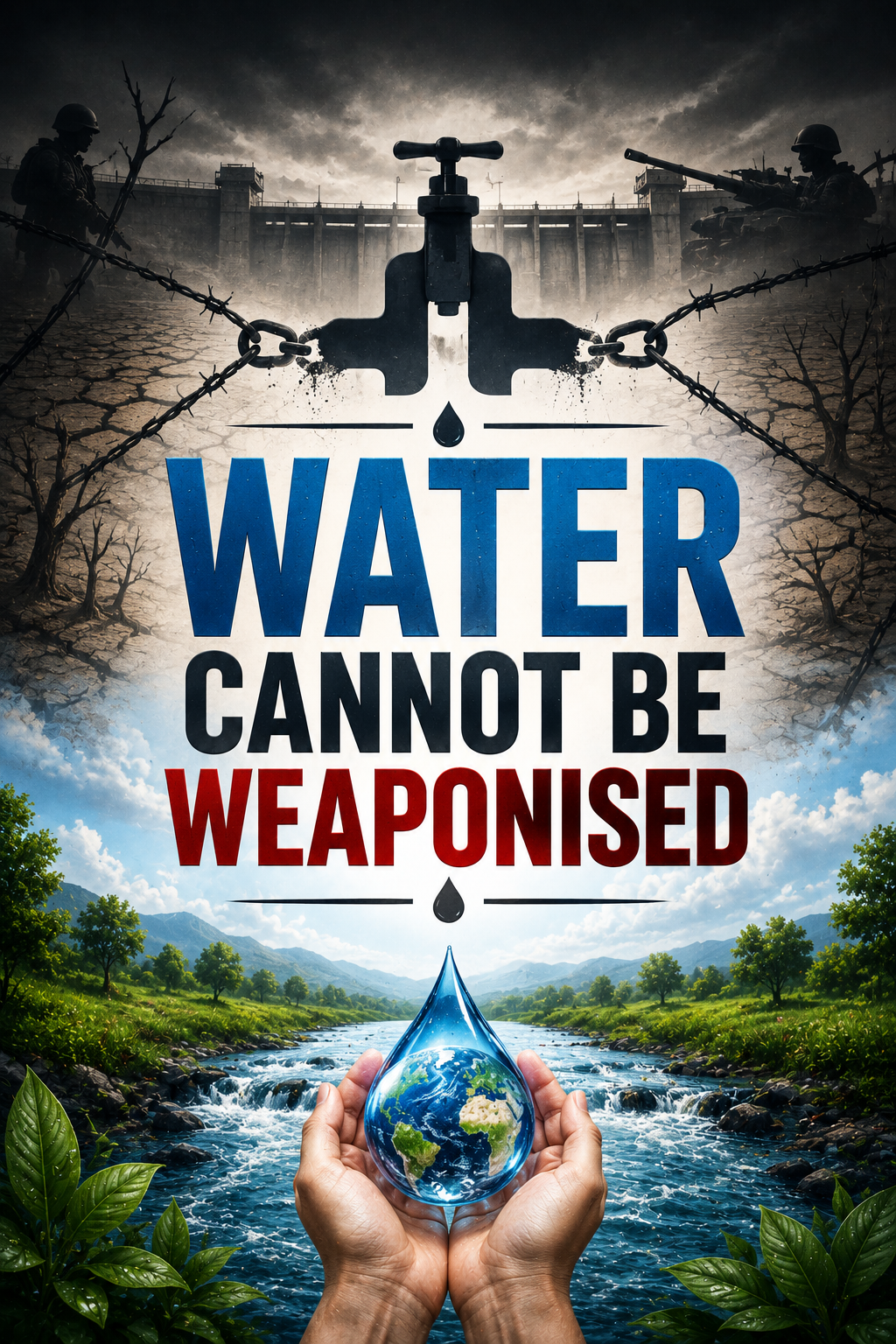
The international community should therefore treat this debate with the seriousness it deserves. Water can be shared, managed and governed. It cannot be allowed to become a political or economic weapon.