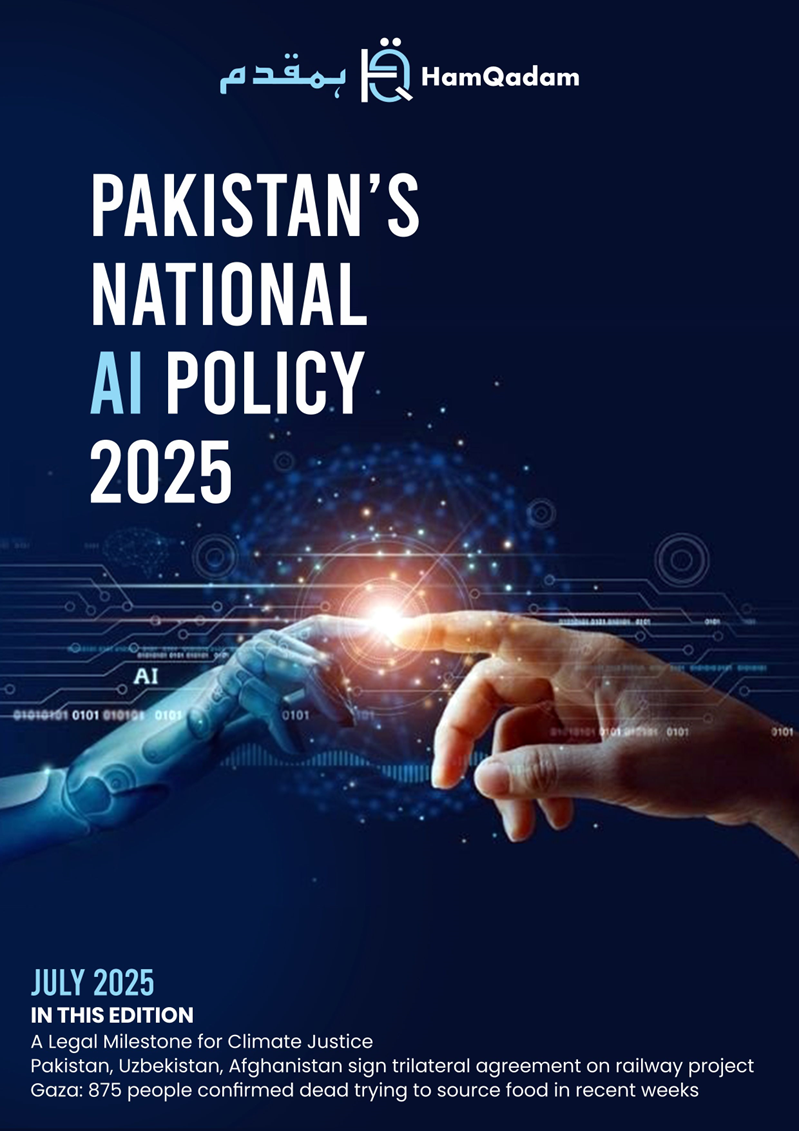
On 30 July 2025, Pakistan’s federal cabinet unanimously approved the National Artificial Intelligence (AI) Policy 2025, marking a significant milestone in the country’s digital transformation agenda. The policy aims to develop a comprehensive AI ecosystem while ensuring the responsible, ethical, and transparent use of artificial intelligence to address national challenges and promote inclusive socio-economic growth. Framed within Pakistan’s broader digital governance architecture, the policy reflects Islamabad’s resolve to modernize its economy and transition toward a knowledge-based and innovation-driven future.
The policy is structured around six strategic pillars designed to guide AI development, adoption, and governance across the public and private sectors. Unlike many AI strategies in South Asia, Pakistan’s policy places a strong emphasis on ethical data governance, human rights, and transparency, distinguishing it in scope and intent. It aligns with international norms, including the United Nations Sustainable Development Goals (SDGs) and UNESCO’s Recommendations on the Ethics of Artificial Intelligence, underscoring Pakistan’s commitment to global best practices.
Pakistan’s AI Evolution and Digital Foundations
Pakistan’s AI journey predates the 2025 policy and has unfolded steadily over the past decade. In 2018, the government launched the Presidential Initiative for Artificial Intelligence and Computing (PIAIC) to build AI, blockchain, cloud, and web development skills among youth. That same year, the National Centre of Artificial Intelligence (NCAI) was established at the National University of Sciences and Technology (NUST) to spearhead research and innovation. Subsequent initiatives included the Cloud First Policy (2022), a National AI Policy draft (2023), and capacity-building programs such as the Certified Cloud Applied Generative AI Initiative (2024).
In 2025, the establishment of the National AI Taskforce and the AI Centre in Peshawar further demonstrated sustained institutional commitment. Collectively, these initiatives laid the groundwork for the National AI Policy 2025, signaling Pakistan’s intention to embed AI at the core of its future economic and governance models.
Vision and Objectives of the National AI Policy 2025
The National AI Policy 2025 envisions AI as a transformative force capable of reshaping Pakistan’s socio-economic landscape. It pursues two core objectives: first, to leverage AI for development by building domestic capabilities, skills, and innovation; and second, to ensure ethical, responsible, and human-centric AI use. On the development front, the policy emphasizes integrating AI into education, cultivating a skilled workforce, strengthening intellectual property protections, promoting research and startups, and enhancing collaboration with global AI leaders.
Equally important are the policy’s ethical objectives. These include safeguarding personal data and privacy, ensuring transparency and accountability in AI systems, preventing algorithmic bias, protecting cultural identity, and fostering inclusive AI adoption. Public awareness and AI literacy are highlighted as essential to building trust and ensuring equitable benefits across society.
The Six Pillars of Pakistan’s National AI Policy
The policy rests on six interlinked pillars. The first focuses on creating a robust AI ecosystem through research and innovation funding mechanisms, notably the proposed National Artificial Intelligence Fund (NAIF). It also calls for the establishment of Centres of Excellence in AI (CoE-AI) in major cities, auxiliary innovation hubs, and venture financing to support AI startups and commercialization.
The second pillar aims to enhance national readiness and awareness by investing in human resource development, AI education, and workforce upskilling. AI literacy campaigns, ethical training, and integration of AI concepts into education and media are central to this effort, ensuring broad-based participation in the AI-driven future.
The third pillar addresses risk management and ethical governance. Recognizing AI’s dual-use nature, Pakistan plans to implement ethical frameworks, cybersecurity protocols, transparency mechanisms, and human oversight systems. An Open-Source AI Governance Framework is also proposed to regulate open-source AI development responsibly.
The fourth pillar targets sectoral AI integration, prioritizing education, healthcare, agriculture, governance, climate resilience, manufacturing, and cultural preservation. The policy sets an ambitious goal of integrating mature AI models into at least 50 institutions by 2026. Legal frameworks for intellectual property rights related to AI—covering patents, copyrights, and data ownership—will be strengthened.
The fifth pillar focuses on digital infrastructure, including high-performance computing centers, national data repositories, cloud infrastructure, and the development of indigenous large language models. Public-private partnerships are expected to play a key role in building scalable and secure AI infrastructure aligned with global standards.
The sixth pillar emphasizes international collaboration, positioning Pakistan as an active participant in the global AI ecosystem. This includes bilateral and multilateral agreements with AI-advanced countries, participation in international AI forums, joint ventures, adoption of global standards, and the promotion of foreign direct investment, exchange programs, and scholarships.
Policy Implementation and Governance
Effective implementation is central to the policy’s success. An AI Council, chaired by the Ministry of Information Technology and Telecommunication and comprising multiple federal stakeholders, will oversee policy execution, resource allocation, ethical compliance, and inter-sectoral coordination. A dedicated Policy Implementation Cell will provide operational support, monitor progress, and recommend adjustments to ensure alignment with policy objectives.
Challenges, Risks, and Strategic Recommendations
Despite its comprehensive design, the National AI Policy 2025 faces several challenges. These include coordination across federal and provincial levels, infrastructure gaps, shortages of trained AI professionals, and concerns related to transparency, accountability, and data governance. Addressing these challenges will require sustained political commitment, institutional capacity-building, and public-private collaboration.
A major concern highlighted in the policy discourse is the militarization and misuse of AI. As a dual-use technology, AI can be exploited for cyber warfare, autonomous weapons, mass surveillance, and disinformation. Pakistan has consistently advocated for international regulation of AI, particularly in military applications, at global forums. The policy underscores the need for a non-discriminatory and transparent international mechanism to regulate AI, monitor military uses, control exports and imports of AI technologies, and prevent misuse by non-state actors.
The growing use of AI by terrorist groups such as BLA, TTP, and IS-KP, along with the convergence of AI and cyber capabilities, further heightens security risks. Civilian data collected for healthcare, education, and agriculture can be repurposed maliciously, raising urgent ethical and governance concerns.
Conclusion
Pakistan’s National AI Policy 2025 represents a forward-looking and balanced approach to artificial intelligence—one that seeks to harness innovation and economic opportunity while safeguarding ethics, human rights, and national security. By combining ecosystem development with strong governance mechanisms, the policy positions Pakistan to benefit from the AI revolution while mitigating its risks. Its success, however, will depend on effective implementation, sustained investment in human capital and infrastructure, and proactive engagement at the global level to shape fair and responsible AI governance worldwide.
Top of Form