Opening Snapshot: Why Should a Student Care About a Defence Agreement?
(≈150 words)
When Ali scrolls through the news between lectures, the headline barely slows him down: Pakistan and Saudi Arabia sign Strategic Mutual Defence Agreement. It sounds distant—something for generals, diplomats, and policy experts. He saves it for “later,” knowing he probably won’t return.
Yet the world Ali is studying in is changing fast. Wars erupt without warning. Alliances shift. Even countries hosting major global powers find their security uncertain. Suddenly, geopolitics is no longer abstract—it shapes economies, job markets, migration, and the moral choices nations make.
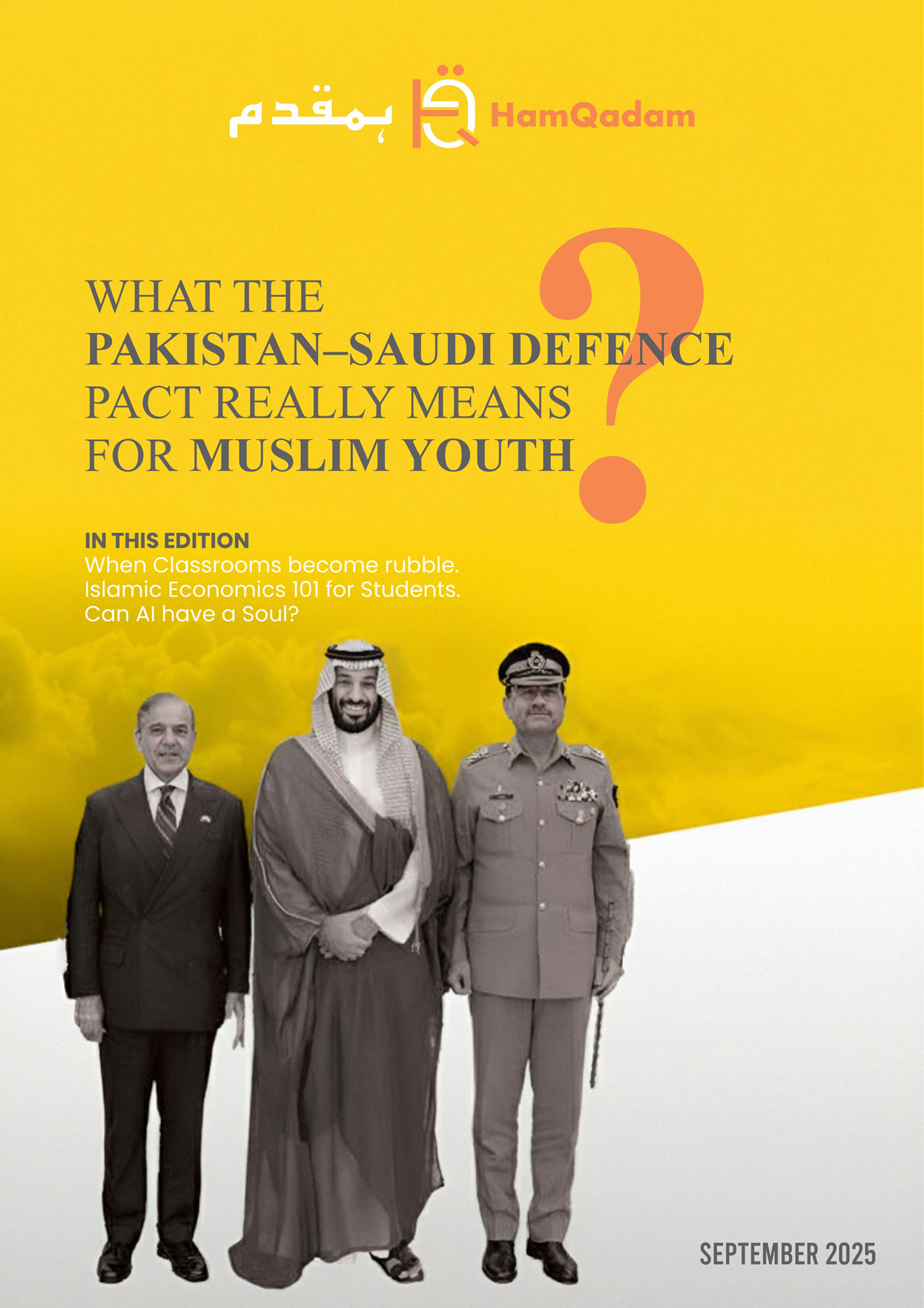
For young Pakistanis and Muslims, the 2025 Pakistan–Saudi Strategic Mutual Defence Agreement is not just a foreign policy footnote. It raises deeper questions: What does security mean in an unstable world? How do Muslim states protect themselves without becoming pawns? And what role will today’s students play in tomorrow’s strategic decisions?
Understanding this agreement is not about memorizing details—it’s about understanding the world you are inheriting.
Why This Issue Exists: From Informal Trust to Formal Commitment
Pakistan and Saudi Arabia have cooperated militarily for decades—long before treaties and joint statements. Pakistani officers helped train Saudi air and ground forces as early as the 1960s. Joint exercises, deployments, and advisory roles created deep institutional trust.
So why formalize it now?
The Middle East has entered a phase of acute uncertainty. Recent strikes in the Gulf region, carried out despite international norms and external security guarantees, have shaken confidence in existing global protection mechanisms. For many regional states, the message was clear: verbal assurances are no longer enough.
In this environment, the Strategic Mutual Defence Agreement (SMDA) marks a shift from assumed support to explicit obligation. By stating that aggression against one will be considered aggression against both, Pakistan and Saudi Arabia have moved from cooperation to codified deterrence.
This was less a sudden decision and more the logical outcome of decades of shared defence experience—formalizing what already existed in practice.
What Students Often Get Wrong About Defence Pacts
Many young people see defence agreements through a narrow lens:
- “This is just about India.”
- “It doesn’t affect civilians.”
- “Pakistan is being pulled into Middle Eastern conflicts.”
The reality is more nuanced.
The agreement is not explicitly India-centric. It reflects Saudi Arabia’s broader strategy of diversifying security partnerships and Pakistan’s effort to assert relevance beyond South Asia. At the same time, any binding defence commitment inevitably reshapes regional calculations, including how other powers perceive Pakistan.
Another misconception is that security policy is morally neutral. In truth, defence choices involve ethical trade-offs: deterrence versus escalation, autonomy versus dependency, and protection versus overreach.
For students, the key lesson is this: foreign policy is not just about power—it is about responsibility.
Global & Pakistani Context: Why This Matters Now
The SMDA signals a subtle but important shift in global security thinking. For decades, many Muslim countries relied heavily on distant great powers for protection. Recent events suggest that such guarantees may be unreliable or selectively enforced.
By strengthening ties with Pakistan—a Muslim country with professional armed forces and long-standing institutional cooperation—Saudi Arabia is recalibrating its security architecture. For Pakistan, the agreement enhances strategic visibility and reinforces its identity as a credible defence partner, not merely a recipient of alliances.
However, greater relevance also means greater scrutiny. Pakistan’s decisions in regional crises will now be watched more closely, increasing the need for strategic maturity and diplomatic restraint.
This is the world today’s students will graduate into: multipolar, unstable, and ethically complex.
Islamic Lens: Security as Amanah, Not Aggression
Islam does not reject strength; it disciplines it.
The Qur’anic principle of preparing strength is tied to deterrence and protection, not domination. The Seerah of the Prophet ﷺ shows treaties, alliances, and defence preparedness aimed at preventing conflict and protecting communities, not provoking war.
From this perspective, a defence agreement between Muslim states can be understood as an amanah—a trust to safeguard lives, sovereignty, and regional stability. But this trust demands restraint, justice, and accountability.
Power without ethics leads to oppression. Ethics without power leads to vulnerability. Islam calls for balance—and that balance must inform modern statecraft as much as personal conduct.
Ethical Tensions & Trade-offs
The SMDA also raises difficult questions:
- How does Pakistan avoid entanglement in conflicts beyond its capacity or interest?
- How can deterrence be maintained without escalating regional arms races?
- How do Muslim states cooperate without reproducing the power politics they often criticize?
These tensions have no simple answers. But ignoring them is far more dangerous than debating them.
For youth, this is a reminder that strategic literacy is a moral skill, not a luxury.
Action Framework: If You’re a Student, Here’s Your Roadmap
- Develop Strategic Awareness
Follow credible foreign policy analysis—not just headlines. - Study Power with Ethics
International relations, security studies, economics, and ethics belong together. - Build Relevant Skills
Research, writing, data analysis, and critical thinking are vital for policy spaces. - Reject Binary Thinking
Not every alliance is blind loyalty; not every critique is disloyalty. - Engage, Don’t Withdraw
Student journals, debates, and policy forums are entry points to influence. - Anchor Yourself Morally
Let Islamic principles guide how you think about power, justice, and responsibility.
Closing Reflection: Youth as Future Custodians of Security
(≈120 words)
The Pakistan–Saudi Strategic Mutual Defence Agreement is not just a document between states—it is a sign of the times. A world where uncertainty is rising, alliances are being rethought, and Muslim countries are seeking greater ownership of their security.
For students, the real question is not whether this agreement is “good” or “bad,” but whether we are preparing ourselves to understand and shape such decisions in the future.
Security is not only defended by soldiers. It is sustained by thinkers, diplomats, analysts, and citizens with moral clarity.
The youth of today will inherit these commitments tomorrow. The choice is simple: remain spectators of power—or become responsible custodians of it.